Het volledige voorstel
Make Nights: Using AI Together
Studenten, AI en erbij horen aan de TU Delft. Voorstel aan het Investeringsfonds van de TU Delft (Kwaliteitsafspraken), ronde 2026.
Draft of 25 November 2026. Het voorstel wordt in het Engels ingediend en staat hier in het Engels.
De korte versie op het formulier van de raad (pdf, 5 pagina’s) Dit voorstel als pdf (16 pagina’s)
Inhoud
Items in [square brackets] are to be confirmed with the named people before submission.
1 Applicants
| Role | Name | Faculty / unit |
|---|---|---|
| Lead applicant | Prof. dr. ir. Pieter Desmet (TU Delft Leermeester 2026) | IDE, Human-Centered Design; Delft Institute of Positive Design |
| Co-applicant | Dr. ir. Sijia Wu | IDE, Design, Organisation and Strategy (Education Fellow 2027) |
| Co-applicant, coordinator | Dr. Derek Lomas | IDE, Human-Centered Design (Positive AI) |
| Co-applicant | Ianus Keller | IDE, Design Project 2 |
| Co-applicant | [Dr. Gosia Migut, to confirm] | EEMCS |
| Researcher | Antong (Jeffrey) Zhang, PhD candidate | IDE |
| Researcher | Aleksander Buszydlik, PhD candidate | [faculty, to confirm] |
| Alumni partner | Emma Furia | Recent TU Delft graduate [programme, to confirm]; co-founder of MakeMode (see Conflict of interest) |
| Student partners | Paid student AI Hosts (aim: sixteen, two from each of the eight faculties) and one paid student coordinator | All eight faculties |
| Advisor | [Dr. Roy Bendor, to confirm] | IDE, Working Group on GenAI and Education |
| Advisor | [Roel Visseren, to confirm] | TU Delft AI Guild, chair of AI Literacy and Awareness |
2 Vision
Every TU Delft student leaves able to say: “With AI and with each other, we made something none of us could have made alone, and it is ours.”
The key word is together. Left alone with a chatbot, students do more and learn less, and they know it. AI makes work easier, but it splits their sense of competence down the middle, frustrates their values more than any other need, and quietly replaces the classmate: the question that would have gone to a peer now goes to AI, and the small moments in which a community forms fall away (Zhang, Desmet & Lomas, in preparation). The answer is not less AI but more of each other. When students build with AI in mixed teams, they learn from how others prompt, judge and decide; they hold each other to work they can stand behind; and AI becomes a reason to meet.
The project turns the current situation around on four fronts:
- Doing more, together. Students build with AI in teams across faculties and years, so the skill spreads from student to student and AI adds to the group rather than replacing it.
- Learning more. Students decide what to hand over and what to keep, so AI extends what they can do instead of skipping what they came to learn.
- Still ours. The work stays the team’s own: they can explain it, change it and stand behind it.
- For something that matters. Students point AI at problems that matter to others, with European, clean-powered tools whose costs are stated openly.
The project starts from three needs:
- Competence. Students find out how far they can reach. They get their hands dirty and build things they thought were beyond them, deep technology included: a program for a quantum computer, a part designed in CAD and printed.
- Autonomy. Working with AI is not only learning to say clearly what you want. It is also finding out what you want, and so getting to know yourself.
- Belonging. Students feel part of a group that does interesting things on campus, linked to study associations, student teams and alumni.
This is not AI literacy as a list of skills. It is learning to work with AI the way one works with good collaborators, human and otherwise: knowing what you want, judging what comes back, and remaining the authors.
3 Summary
Almost every TU Delft student now uses generative AI, and most taught themselves or learned from a peer. Employers increasingly expect graduates to work with AI every day. Yet students tell us AI can leave them feeling guilty, anxious or like a fraud, and that it tempts them to skip the thinking their education is meant to build. In a TU Delft survey of 116 industrial design master students, AI made work easier more than it did anything else, but the same students reported that skills went unbuilt and that work no longer felt like their own: they do more and learn less, and they know it while it happens. Course guidance is usually a ban or an instruction to “use it critically”, which gives students nothing to practise.
We propose one method for upskilling the student body for an AI-rich working life, in a way that is fun, builds belonging, and protects the quality of learning. It builds on how students already learn AI, from each other, and gives that structure. Students learn by building things with AI together, led by trained fellow students:
- Make Nights: interfaculty evenings, open to all TU Delft students and not tied to any course. Mixed teams from different faculties make something real with AI, from apps to CAD parts and quantum programs, and show it at the end of the night. With lightning talks, pizza and student DJs.
- AI Hosts: paid students, ideally two from each of the eight faculties, trained to run Make Nights and short sessions inside large project courses.
- In-course sessions: short, ready-made activities in challenge-based project courses, a kind of education taught across TU Delft, that teach students to decide when and how to use AI so that they keep learning.
- The AI Pulse: a new twice-yearly check-in on how students feel about AI, reported to the Central Student Council so that students’ experience informs university policy.
Most of the budget goes directly to students: paid host roles, the events, and equal access to AI tools that are hosted in Europe and run on renewable power. That choice answers the concerns students raise most strongly: what AI costs the planet, what happens to their data, and whether using it fits their values. The research behind the method is carried by two existing PhD positions and staff time.
We keep the firm commitments few and within our own control, and state the larger numbers as aims. The project starts small, grows with what works, and scales with the budget the fund awards.
4 Introduction and fit with the themes
The project contributes to both priority themes of this call.
Future proof education: AI and AI literacy, and student success. Working with AI well is becoming a core professional skill for engineers and designers: describing clearly what you want, judging what comes back, deciding what to hand over and what to do yourself, and knowing when not to use AI at all. These skills are learned by doing. The method gives every participating student repeated, hands-on practice, with equal access to tools so that AI literacy does not depend on who can afford a subscription. Because the in-course activities are designed to keep students’ own thinking in the loop, they support learning and study success rather than shortcuts.
Sense of belonging: student wellbeing and a vibrant campus. AI is changing how students feel about their work and about themselves as future engineers, and it can isolate them: the chatbot replaces the classmate. Make Nights turn AI into a reason to meet: hosted evenings with making, lightning talks, food and music, linked to study associations, student teams and alumni. Mixed teams bring together first-year and senior students, Dutch and international students, and students from different faculties. The AI Pulse measures wellbeing directly, using an established framework of fundamental needs (autonomy, competence, relatedness, stimulation, purpose, security), so that the project can show whether it helps.
The project is faculty-transcending by design: hosts are recruited from all eight faculties, in-course sessions start in IDE and extend to other faculties, and Make Nights are open to every TU Delft student.
Fit with TU Delft’s own direction. IDE’s Vision for Addressing Generative AI Tools in Design Education (Working Group on GenAI and Education, fifth draft, May 2026) asks the faculty to “provide AI literacy for all”, to “protect students’ rights and wellness”, to “ensure that no student is left behind due to the cost of GenAI”, to “mitigate dependency”, to “promote safe experimentation”, to “develop monitoring mechanisms to track tool use, consequences, and learning objectives”, to maintain dialogue with alumni and industry, and to “encourage staff and students to initiate different kinds of events”. It also asks the faculty to consider EU-based, GDPR-compliant tools. This project puts those principles into practice, tests them with students from other faculties, and contributes to the TU Delft AI Guild’s work on AI literacy and awareness. It offers the faculties an evidence base rather than another policy.
5 Problem and need
- Students do more and learn less, and they know it. A needs survey of 116 IDE master students (Zhang, Desmet & Lomas, in preparation) asked how their AI use satisfies and frustrates each of thirteen fundamental needs. Ease was the only need AI satisfied more than it frustrated (76% rated satisfaction 5 or higher on a 7-point scale). Competence split the cohort almost exactly in half (mean satisfaction 3.96, frustration 4.07): students feel more capable when AI lets them reach beyond their own skill, and less capable when skills are not built or lost and they feel small next to AI. Morality was the most frustrated need (62% rated frustration 5 or higher), followed by security and beauty. The same students reported both satisfaction and frustration, often in the same answer. The study identified seven recurring tensions, among them effort removed, skill not built; help that becomes dependence; asking AI instead of people; and better work, less ownership.
- Students’ strongest objections are about what AI is, not what it does for them. In the same survey, morality, security and beauty were the most frustrated needs. Students named AI’s energy and water use, training on creative work without consent, exposed data, and an uncertain future as designers. Many use AI anyway, and the guilt is strongest when the work is good: students who want their designs to do good find themselves using a tool they believe does harm. A ban leaves that gap with the individual student; a stated choice of tools and purposes can close part of it.
- Use is widespread and self-taught. A recent IDE faculty survey found that students have widely adopted tools such as ChatGPT, Gemini and Midjourney, and that most taught themselves.
- Students experience a loss of agency. Interviews from a Senior University Teaching Qualification project in IDE show that turning to AI for ideas becomes a habit even when the ideas are generic, and that students worry about the consequences of their AI use and feel they are losing control of their own work.
- Shortcuts follow assessment. Ongoing PhD research at TU Delft on shortcut-seeking with AI shows that students take shortcuts where assessment rewards the finished product rather than the learning. Training students without supporting teachers has limited effect.
- Current guidance does not help. A ban, or a general instruction to use AI critically, does not tell a student what to do with a design brief or a programming assignment in front of them.
- Access is unequal. Some students pay for the most capable AI tools and others cannot. That gap is becoming a gap in learning.
- Working life is changing fast. Experienced engineers increasingly build software and designs in conversation with AI. Students see this and are unsure what they are supposed to learn themselves. They need practice and community, not only rules. IDE’s vision document names this directly: “a growing gap between what industry expects of new graduates and what design education currently prepares them for”. Yet we have little evidence about how professionals actually experience working with AI day to day, what they find rewarding or draining, and which skills they rely on.
6 Goals
- Give about 1,200 students from five or more faculties hands-on practice in working with AI well.
- Strengthen belonging by bringing students from different faculties, years and backgrounds together to build things.
- Protect the quality of learning by helping students decide when and how to use AI, and by giving teachers of large project courses ready-made activities and reflection formats.
- Give students a voice in how TU Delft responds to AI, through the AI Pulse reported to the Central Student Council.
- Leave behind a student-run structure and open materials that faculties and study associations can continue.
7 Commitments and aims
We separate what we commit to from what we aim for. The commitments are few and within the team’s own control. The aims depend on how many students, hosts and course teams come forward, and we will report honestly on how far we got.
We commit to:
- A trained team of paid student AI Hosts, at least eight students from at least four faculties, in place by February 2027.
- At least eight Make Nights between February 2027 and January 2028, open to students of all faculties.
- In-course sessions in at least two large project courses during 2027.
- Two AI Pulse rounds (spring and autumn 2027) and two reports to the Central Student Council (July 2027 and February 2028), which say what worked and what did not.
- An open set of teaching and reflection materials for all TU Delft teachers, published by February 2028.
We aim for: about 1,200 students from five or more faculties taking part; sixteen Hosts, two in each of the eight faculties; twelve Make Nights with 40 to 60 students each; course sessions in four courses in three faculties; about 150 students in each AI Pulse round; students who leave more confident with AI and better connected to each other; and study associations and course teams that choose to carry the method on.
The project scales. It starts small, with a few Hosts and one course, and grows with what works. The budget is sized for the aims: host hours, evenings and tool access are paid only as they are used, and money that is not needed is not spent. A smaller award means fewer Hosts, evenings and faculties, with the same method.
8 Impact model
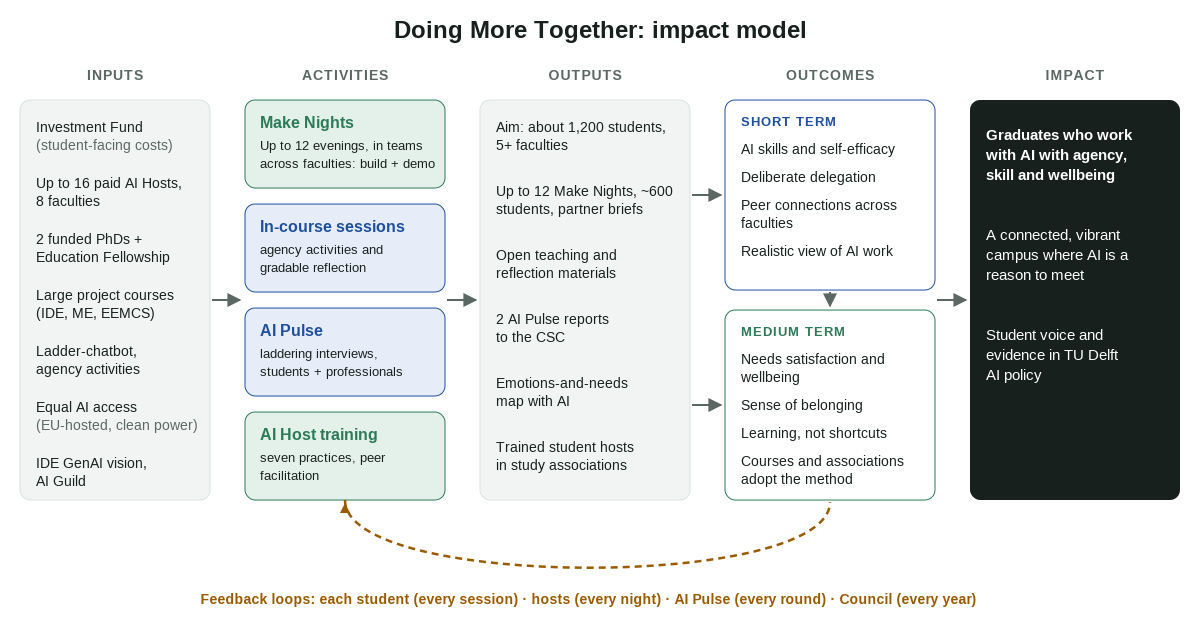
Core idea. AI can make students feel more competent or less. They feel more competent when AI expands what they can do and the result is still theirs: they can explain it, change it and stand behind it. They feel less competent when the result works but does not feel like them, or when a skill they came to learn goes unbuilt. The method aims at the first and away from the second, and its main lever is other students. Working alone with AI, a student has no one to learn from, no one to explain the result to, and no one to notice when the work stops being theirs. Working in a team, students see how others prompt, judge and decide, they have to explain and defend what they made, and AI becomes something the group uses rather than something that replaces the group. Around that core sit two supports: understanding how AI use makes students feel and why, and practising deliberate choices about what to hand over. Peer-led, social practice makes this fun and builds belonging. Measurement after each round keeps the activities aimed at what students actually need.
Assumptions the model rests on, and how we check them:
- Students will come to optional evening events about AI. Check: attendance per Make Night; recruitment through study associations rather than staff.
- Course teams will make room for short activities. Check: confirmed course partners before launch; activities replace existing exercises.
- Self-reported agency and needs satisfaction change within one year. Check: before and after measures in both rounds.
- Student hosts can run sessions well with short training. Check: participant feedback per session; staff support at the first sessions.
9 Research base
The method builds on established research rather than inventing new theory.
- Needs and wellbeing. Wellbeing depends on satisfying basic psychological needs, above all autonomy, competence and relatedness (self-determination theory; Ryan & Deci, 2000). Desmet and Fokkinga (2020) extend this into thirteen fundamental needs for design, which gives the AI Pulse its vocabulary. Satisfaction and frustration of a need are not two ends of one scale: a student can feel capable and, at the same moment, feel that the capability is not theirs (Zhang, Desmet & Lomas, in preparation). We therefore define competence with AI as the sense that AI expands what one can do while the work remains one’s own.
- AI can reduce thinking and learning. Knowledge workers who trust AI more report less critical thinking, while those confident in their own skills think more critically (Lee et al., 2025). In a field experiment with secondary-school students, unrestricted access to a chatbot improved practice performance but harmed later learning, while a version designed to support learning largely avoided that harm (Bastani et al., 2025). Professionals using AI gain on some tasks and lose accuracy on others, the “jagged frontier” (Dell’Acqua et al., 2023).
- AI can narrow creativity. AI-assisted stories were rated more creative individually but became more similar to one another (Doshi & Hauser, 2024), which echoes the classic problem of design fixation (Jansson & Smith, 1991). The in-course agency activities target this directly.
- Agency can be learned. Self-regulated learning research shows that planning, monitoring and reflecting on one’s own learning can be taught (Zimmerman, 2002). The agency activities apply this to decisions about AI.
- Learning by making, with peers, through play. Creative learning grows through projects, passion, peers and play (Resnick, 2017), building on constructionism (Papert, 1980). Peer-led learning benefits both the learners and the peer leaders (Topping, 2005). This is the basis for Make Nights and AI Hosts.
- Belonging can be strengthened. Brief, well-designed interventions that address belonging improve both academic and wellbeing outcomes (Walton & Cohen, 2011).
- Assessment shapes behaviour. Students learn what assessment rewards, so learning activities and assessment must be aligned (Biggs, 1996). The in-course sessions include gradable reflection for this reason.
- Laddering. The AI Pulse uses the laddering interview technique, which links concrete experiences to underlying values by repeatedly asking why something matters (Reynolds & Gutman, 1988).
- Local evidence. The needs survey of 116 IDE master students described above (Zhang, Desmet & Lomas, in preparation), IDE’s student survey (2025) and staff survey (2025–26), summarised in the faculty’s GenAI vision document (2026), and the SUTQ interviews behind Sijia Wu’s fellowship.
10 The method
10.1 What students learn
The method trains seven practices that matter for working with AI, each linked to a basic need:
| Practice | What students do | Need it supports |
|---|---|---|
| Knowing what you want | Find out what you want by trying things and reacting to the results; describe a goal clearly enough that someone, or something, else can build it | Autonomy |
| Reaching further, and owning it | Use AI to make things beyond your current skill, then check, test, explain and change the result until you can stand behind it | Competence |
| Deciding what to delegate | Choose on purpose what to hand to AI and what to do yourself; keep the parts you came to learn; try the same task without AI first | Autonomy, competence |
| Playing and exploring | Make many versions quickly; ask for ideas from unrelated domains to escape fixation | Stimulation |
| Working with people | Build in teams; use AI to prepare for real users and conversations, not to replace them | Relatedness |
| Holding a vision | Keep a point of view about what the work is for and judge each result against it | Purpose |
| Using AI for good, at a fair cost | Point AI at problems that matter to others; know the energy, data and rights costs of the tools you use, and choose tools accordingly | Morality, security |
Competence is the need where AI cuts both ways. The goal is not less AI but a particular experience of it: “AI lets me do more than I could before, and it is still me doing it.” The opposite, “it works, but it isn’t me”, is the experience the method is designed to prevent.
Autonomy is more than giving clear instructions. Students often do not know what they want until they see a first result. Working with AI is a way of finding that out, and of getting to know oneself.
10.2 Responsible AI access
Every student who joins a Make Night or a course session gets the same access to capable AI tools for the whole project year, so that AI literacy does not depend on who can pay. Access is a metered allowance of about EUR 75 per student for the year: between EUR 50 and EUR 100 depending on use, with Hosts at the upper end. It is not a subscription: it covers the sessions a student takes part in and their own exploring in between, and allowance that is not used is not charged. For comparison, a standard consumer AI subscription costs about EUR 20 a month. The budget covers 700 students; students who only take part in the AI Pulse do not need tools. The tools are chosen against public criteria set before any tool is considered:
- Hosted in Europe and compliant with GDPR; student data is not used to train models.
- Clean power: the provider runs on renewable energy and publishes it, or the project offsets the measured use through a verifiable scheme.
- Openness where possible: at least one open-weight model is among the options, so students can see that capable AI does not have to come from a handful of companies.
- Fit with TU Delft procurement and privacy requirements.
The project also reports its own AI footprint (estimated energy use and the share on renewable power) in each AI Pulse report, so students can see the cost of the AI they used rather than guess at it. This puts into practice IDE’s call for EU-based, GDPR-compliant tools and for ensuring “that no student is left behind due to the cost of GenAI”.
10.3 Make Nights
Up to twelve evenings over the year, open to students of all faculties. A Make Night is part workshop, part party: time to make, lightning talks, pizza, and music from student DJs. Trained student Hosts run it, in a safe setting close to academic life. It is not tied to any course. AI is changing the world faster than a curriculum can follow, so the themes follow what has just become possible, and they come from students.
Hands dirty. The point is to push AI to its limits and to find out what you can now do. Themes include deep technology as well as apps: a program for a quantum computer, a part designed in CAD and printed, a simulation, a game, a tool for a study association. Some nights are built around a real brief from a social-impact partner, such as a Delft neighbourhood organisation, a non-profit or a sustainability project on campus [partners to confirm]; the partner joins the demos and takes the best results home. Teams of three to five are deliberately mixed across faculties and years, and every night has a no-AI option.
The evening. Doors open around 17:30 with pizza and music. After a short kick-off, two or three lightning talks of five minutes each, by students, alumni or researchers, show what someone has just made. Then about two hours of making in teams, with Hosts walking round. Each team gives a short demo, followed by a vote and a ten-minute look back at how the team used AI: what it handed over and what it kept. After that the DJ plays on and people hang out. This informal time is part of the method: a lot of what can be learned about building with AI is not learned in classes but from time spent with other students who build. Evenings follow TU Delft’s alcohol policy; the fund pays only for food and soft drinks.
Where. Make Nights rotate around the faculties. Each night is held in a different faculty, hosted by that faculty’s Hosts together with its study association, so students get to see buildings and meet groups they would otherwise never visit. One or two larger nights can be held at X, TU Delft’s student sports and culture centre, which also has a DJ studio where we will look for student DJs. [Rooms to be agreed with each faculty and with X.]
Rules for the evening. Each night is agreed in advance with the host building: the room, closing time, sound level, and the emergency-response or security staff the building asks for. TU Delft’s alcohol and substances policy applies, which means no alcohol before 17:00 and nothing stronger than 15 per cent. The fund pays only for food and soft drinks.
Links. Study associations, student teams and alumni groups are invited to co-host a night on a theme of their own, so that Make Nights connect groups that already exist on campus instead of adding one more.
What an evening costs.
| Per evening, for about 50 students (estimates) | EUR |
|---|---|
| Room in the host faculty, with the after-hours and emergency-response staff the building asks for | 400 |
| Sound and light, hired where the faculty has none | 250 |
| Pizza, about EUR 15 per student | 750 |
| Soft drinks: two each at about EUR 2.50 | 250 |
| Student DJ | 200 |
| Materials and small prizes: printing filament, components, computing time | 300 |
| Margin | 350 |
| Total | 2,500 |
For comparison, a night at X costs about EUR 2,800. Its Theatre Hall is EUR 71.90 an hour at the staff rate (EUR 31.90 for students; published rates for September 2026 to August 2027), and food in a hired room at X must come from X’s own catering, whose pinsa dinner is EUR 28.50 per person.
10.4 AI Hosts
Paid student assistants, recruited in cooperation with the faculty student councils and study associations. We aim for sixteen, two from each of the eight faculties, and start with the faculties where students come forward first. Hosts receive a short training from the project team in the seven practices and in facilitating groups. They run Make Nights, co-facilitate in-course sessions, test materials before they reach a course, and help interpret the AI Pulse. Hosts are the main channel through which the project reaches students, and they are the structure that can continue after the project through the study associations. A paid student coordinator (about 380 hours) handles planning, partners and logistics across the faculties.
10.5 In-course sessions (lead: Sijia Wu)
Short activities built into the ideation and reflection phases of challenge-based project courses. This kind of education, in which teams work on an open problem over several weeks, is taught in every faculty, and a few course teams reach thousands of students. They build on Sijia Wu’s Education Fellowship on student agency with AI (starting January 2027). Examples: using AI at the start, middle and end of ideation to see how timing changes the result; prompting for ideas from unrelated domains to reduce design fixation; giving oneself the same task as the AI before comparing. Each activity comes with a reflection format that teachers can use in assessment, so that the course rewards the learning process and not only the product.
Planned courses: Design Project 2 in IDE (about 250 first-year students, February 2027, with Ianus Keller), Design Project 4 in IDE [numbers to confirm], and one course each in EEMCS [with Gosia Migut, to confirm] and Mechanical Engineering [to confirm].
10.6 The AI Pulse (lead: Antong Zhang, Pieter Desmet)
A twice-yearly check-in on how students experience AI. Students take a short laddering interview with an AI interviewer already developed in this PhD project (the Ladder-chatbot), which follows each emotion they report down to the need beneath it by asking “why does that matter to you?”, plus a short needs questionnaire. A sample is followed up with in-depth interviews. For students, the interview doubles as a reflection exercise. Results are summarised in a short report to the Central Student Council after each round, and they shape what the hosts and course sessions focus on next.
10.7 A method built on feedback loops
The method improves itself and its participants through four loops, running at different speeds. Each one turns a measurement into a decision someone actually takes.
| Loop | Speed | What is measured | Who acts on it | What changes |
|---|---|---|---|---|
| The student | Every session | The student’s own reflection: what they felt, what they delegated, and the gap between their “Who did the work?” estimate and the tool’s | The student | Their next choice of what to hand to AI and what to keep. This is the agency the project teaches: notice, choose, make, reflect. |
| The session | Every Make Night and course session | Two-minute exit check: was it fun, did I learn, did I meet someone new, did it feel like my work | AI Hosts | The format, briefs and facilitation of the next session. Hosts meet monthly to compare notes. |
| The round | Twice a year | The AI Pulse: emotions and needs, from laddering interviews and the needs questionnaire, with the professional comparison | Steering group, course teams | Which activities are kept, revised or dropped; which needs the next round targets. H6 tests whether this loop works. |
| The institution | Yearly | AI Pulse reports, course comparisons (RQ3) and the project’s AI footprint | Central Student Council, faculties | Policy on AI in education, assessment, and which tools TU Delft provides. Students’ experience becomes evidence in the decisions that shape it. |
The loops share one vocabulary, the fundamental needs, so what a student notices about themselves on a Tuesday night uses the same words as what the Council reads in July.
10.8 A shared measure: “Who did the work?”
In sessions, students can record how much of the thinking was theirs, and the tool gives its own estimate. The gap is a prompt for reflection, and across many sessions it shows when students delegate thoughtfully and when out of habit.
11 Target group and reach
| Activity | Students (aim) | When |
|---|---|---|
| Make Nights (up to 12 evenings, all faculties) | 40 to 60 per evening, about 600 in total | February 2027 to January 2028 |
| Design Project 2, IDE | about 250 first-year BSc | February 2027 |
| Design Project 4, IDE | [number, to confirm] | 2027 |
| Course pilots in EEMCS and ME | [numbers, to confirm] | 2027 |
| AI Pulse | about 150 per round, two rounds | spring and autumn 2027 |
| AI Hosts | up to 16 students from 8 faculties | December 2026 to January 2028 |
Aim: about 1,200 students take part in at least one activity, from five or more faculties. These numbers are aims, not guarantees; the firm commitments are listed under Commitments and aims.
12 Student involvement and governance
Students run the method. The AI Hosts design and lead the activities, and the Make Night themes come from students. Emma Furia, a recent graduate, connects the project with recent alumni, who join Make Nights as guests and take part in the professional round of the AI Pulse. A small steering group meets every two months: the lead applicant, the coordinator, two AI Hosts, and [a member of the Central Student Council, by invitation]. The steering group decides on themes, priorities and the choice of AI tools.
13 Research and evaluation
The research is what makes the method improve during the year and what lets the Central Student Council judge whether it worked. It is carried out within existing positions (two PhD projects and staff time), so the fund pays only for small research costs. Results feed back into the activities after each round, which makes the project a feedback loop between understanding students and supporting them.
What the project owes the fund from this research is the two AI Pulse reports. The questions and expectations below belong to the existing research projects; they describe what we hope to learn along the way and are not deliverables of this grant.
13.1 Research questions
| Question | Lead | Data |
|---|---|---|
| RQ1. Which positive and negative emotions do students experience when working with AI, and which underlying needs explain them? | Antong Zhang, Pieter Desmet | AI Pulse laddering interviews, needs questionnaire, in-depth interviews |
| RQ2. Which activities help students make deliberate decisions about when, where and how to use AI in ideation, and do they strengthen students’ sense of agency? | Sijia Wu | In-course sessions: before and after measures, reflections, “Who did the work?” data |
| RQ3. How do course format and assessment shape whether students use AI to learn or to take shortcuts? | Aleksander Buszydlik, Gosia Migut | Comparison across IDE, EEMCS and ME courses; teacher and student interviews |
| RQ4. Do social making events with AI improve students’ AI skills and sense of belonging? | Derek Lomas | Make Night participants before and after, compared with students who did not attend |
| RQ5. How do recent TU Delft alumni and other professionals experience working with AI, and how does that compare with students’ expectations and fears? | Antong Zhang, Derek Lomas | Professional AI Pulse: the same laddering interview with a small group of alumni and professionals (aim: 30 to 50) |
What we expect to find.
- H1 (RQ1). Positive emotions about AI use come from experiences in which AI expands what students can do while the result stays their own (competence satisfied, autonomy intact). Negative emotions (guilt, anxiety, feeling like a fraud, feeling small next to AI) come from experiences in which the result works but does not feel like theirs, or a skill goes unbuilt (competence and autonomy frustrated, alongside morality). This extends the questionnaire findings of Zhang, Desmet and Lomas with laddering interviews across faculties.
- H2 (RQ2). Students who take part in the agency activities report a stronger sense of agency, and delegate more deliberately, than comparison students in the same course.
- H3 (RQ3). Courses that assess the process, including reflection on AI use, show less shortcut-seeking than courses that assess only the product.
- H4 (RQ4). Make Night participants gain more AI self-efficacy and sense of belonging than non-participants, with the largest gains for first-year and international students. Students who build with AI in teams report more competence that feels like their own than when they use AI alone.
- H5 (RQ5). Students’ fears about AI at work differ from professionals’ reported experience, and contact with alumni reduces students’ anxiety about their future work.
- H6 (feedback loop). Activities revised after the first AI Pulse round produce larger gains in round two than the original versions did in round one.
- H7 (RQ1, RQ4). Students who use EU-hosted, renewable-powered tools on social-impact briefs report lower frustration of morality and security needs than they reported about their usual AI use.
13.2 Design
- Mixed methods. Short questionnaires for scale, laddering and in-depth interviews for depth.
- Before and after, with comparison groups. Where possible, participating course cohorts are compared with students in the same course who have not yet taken part, or with the previous year’s cohort on existing course evaluations.
- Two rounds. Spring 2027 and autumn 2027. The first round’s findings revise the activities for the second, so we can see whether the revisions help.
- Students as co-researchers. AI Hosts help interpret findings, and [up to three MSc graduation projects] can build on the data.
- A professional comparison. A small professional round of the AI Pulse, recruited through the alumni networks of the participating faculties, uses the same interview. Students get a realistic picture of AI at work, and the comparison shows which student worries match professional reality and which do not. Interviewed alumni are invited to Make Nights as guests, which connects students with people a few years further along.
13.3 Ethics and data
All data collection is approved by the TU Delft Human Research Ethics Committee before it starts. Participation is voluntary, separate from grading, and can be withdrawn at any time. AI Pulse responses are anonymous. Data are stored on TU Delft systems under a data management plan and handled in line with GDPR.
13.4 Outputs
- Two short AI Pulse reports to the Central Student Council (July 2027 and February 2028), written for students and policymakers.
- An open set of teaching and reflection materials for TU Delft teachers.
- Scientific papers within the PhD projects and the Education Fellowship, with the Investment Fund acknowledged.
13.5 Indicators
- Reach: number of students and faculties per activity.
- Skills: students’ self-reported confidence in the seven practices, before and after.
- Wellbeing: needs satisfaction before and after participation, using the needs questionnaire from the AI Pulse.
- Values: frustration of the morality and security needs, before and after, and, where providers publish the data, an estimate of the project’s AI footprint.
- Social impact: number of partner briefs, and examples of results that partners went on to use.
- Belonging: short questions on connection to peers and the TU Delft community after Make Nights.
- Quality of learning: the “Who did the work?” measure and teachers’ feedback on the in-course sessions.
- Continuation: number of study associations and course teams willing to continue Make Nights or the course activities after the project.
Milestone at six months (July 2027): report to the Central Student Council with reach so far, first AI Pulse results, and a go/adjust decision for the second half of the year.
14 Timeline
Dates assume a decision in December 2026 and shift with the date of the decision.
| Period | Activities |
|---|---|
| Dec 2026 to Jan 2027 | Recruit and train AI Hosts; set up tool access; prepare materials; ethics approval |
| Feb 2027 | Design Project 2 sessions; first Make Night; first AI Pulse round |
| Mar to Jun 2027 | Course sessions in further courses; Make Nights continue |
| Jul 2027 | Six-month report to the Central Student Council; revise materials |
| Sep 2027 to Jan 2028 | Second round in courses; Make Nights continue; second AI Pulse round |
| Feb 2028 | Final report; open release of materials; handover to study associations and course teams |
15 Budget
| Item | Calculation | Amount (EUR) |
|---|---|---|
| AI Hosts (paid student assistants) | 16 students x 82 hours x EUR 39 | 51,168 |
| Student coordinator: planning, partners, logistics | 246 hours x EUR 39 | 9,594 |
| Host training and facilitation materials | 5,000 | |
| Make Nights: room, pizza and soft drinks, student DJ, sound, materials (see Make Nights) | 12 evenings x EUR 2,500 | 30,000 |
| Equal AI tool access for participating students (EU-hosted, renewable power) | 700 students x EUR 75 of metered use for the year | 52,500 |
| Teaching and reflection materials for course teams | 6,000 | |
| AI Pulse: thank-you vouchers for in-depth interviews | 150 x EUR 20 | 3,000 |
| Research support: interview transcription and a student research assistant | 5,000 | |
| Closing showcase | 2,500 | |
| Contingency (9%) | 15,238 | |
| Total requested | 180,000 |
Not requested from the fund: staff and PhD time, including research design and analysis, which are covered by existing PhD positions and staff hours.
Student hours are costed at EUR 39 per hour, the cost of a student assistant hired through FlexDelft.
The budget scales. It is sized for the aims. Host hours, evenings and tool access are paid only as they are used, and money that is not needed is not spent. A smaller award means fewer Hosts, evenings and faculties, with the same method: at about EUR 90,000 the project runs in four faculties, with eight Hosts and eight Make Nights.
16 Continuation after the project
The method is designed to outlast the grant. AI Hosts are recruited through the study associations, which can continue Make Nights with modest support. The in-course activities and reflection formats are built into existing courses and published openly for any TU Delft teacher. The Education Fellowship continues the agency work, and the two PhD projects continue the AI Pulse research. The six-month report gives faculties the evidence to decide on structural support.
17 Risks and mitigation
| Risk | Mitigation |
|---|---|
| Fewer students, hosts or course teams come forward than hoped | Start small with the faculties that respond first; costs follow use, so a smaller project costs less; the six-month report includes a go/adjust decision |
| Make Nights draw only students who already like AI | Themes chosen by students from different faculties; hosts recruit through study associations; teams deliberately mixed; a no-AI option at every event |
| Course teams cannot fit new activities into their schedule | Activities are short and replace existing ideation and reflection exercises rather than adding work |
| Students feel judged for their AI use | Participation is voluntary; the framing is learning, not policing; no results feed into grades; AI Pulse responses are anonymous |
| Privacy of student conversations with AI tools | Only tools that meet TU Delft privacy requirements are used; data collection follows ethics approval and GDPR |
| Claims of clean power cannot be verified | Only providers that publish their energy sourcing qualify; otherwise measured use is offset through a verifiable scheme; the footprint is reported openly |
| AI tools change during the project | The method teaches decisions and habits, not features of a particular tool |
18 Conflict of interest
Derek Lomas and Emma Furia are co-founders of MakeMode, a company that provides AI tools for education. For Derek Lomas this is registered as an ancillary activity. To keep this separate from the project:
- The budget for AI tool access is tool-neutral. The selection criteria (European hosting, renewable power, openness) are fixed in this proposal before any tool is considered, and several providers meet them. The steering group chooses the tools, following TU Delft procurement rules. Neither Derek Lomas nor Emma Furia takes part in that decision; for Derek Lomas this follows his registered undertaking.
- MakeMode may be one of several tools offered, at a price no higher than its standard educational price, and only if the steering group selects it.
- No project funds are paid to any company in which an applicant has an interest without this being disclosed to the Central Student Council in advance.
References
Bastani, H., Bastani, O., Sungu, A., Ge, H., Kabakcı, Ö., & Mariman, R. (2025). Generative AI without guardrails can harm learning: Evidence from high school mathematics. Proceedings of the National Academy of Sciences, 122(26).
Biggs, J. (1996). Enhancing teaching through constructive alignment. Higher Education, 32, 347–364.
Dell’Acqua, F., McFowland, E., Mollick, E., et al. (2023). Navigating the jagged technological frontier: Field experimental evidence of the effects of AI on knowledge worker productivity and quality. Harvard Business School Working Paper 24-013.
Desmet, P. M. A., & Fokkinga, S. F. (2020). Beyond Maslow’s pyramid: Introducing a typology of thirteen fundamental needs for human-centered design. Multimodal Technologies and Interaction, 4(3), 38.
Doshi, A. R., & Hauser, O. P. (2024). Generative AI enhances individual creativity but reduces the collective diversity of novel content. Science Advances, 10(28).
IDE Working Group on GenAI and Education (2026). A vision for addressing generative AI tools in design education at IDE (fifth draft, 5 May 2026). TU Delft.
Jansson, D. G., & Smith, S. M. (1991). Design fixation. Design Studies, 12(1), 3–11.
Lee, H.-P., Sarkar, A., Tankelevitch, L., Drosos, I., Rintel, S., Banks, R., & Wilson, N. (2025). The impact of generative AI on critical thinking: Self-reported reductions in cognitive effort and confidence effects from a survey of knowledge workers. Proceedings of CHI 2025.
Papert, S. (1980). Mindstorms: Children, computers, and powerful ideas. Basic Books.
Resnick, M. (2017). Lifelong kindergarten: Cultivating creativity through projects, passion, peers, and play. MIT Press.
Reynolds, T. J., & Gutman, J. (1988). Laddering theory, method, analysis, and interpretation. Journal of Advertising Research, 28(1), 11–31.
Ryan, R. M., & Deci, E. L. (2000). Self-determination theory and the facilitation of intrinsic motivation, social development, and well-being. American Psychologist, 55(1), 68–78.
Topping, K. J. (2005). Trends in peer learning. Educational Psychology, 25(6), 631–645.
Walton, G. M., & Cohen, G. L. (2011). A brief social-belonging intervention improves academic and health outcomes of minority students. Science, 331(6023), 1447–1451.
Zhang, A., Desmet, P., & Lomas, D. (in preparation). Doing more, learning less: A needs study of design students’ AI use. Manuscript for E&PDE 2027, TU Delft.
Zimmerman, B. J. (2002). Becoming a self-regulated learner: An overview. Theory Into Practice, 41(2), 64–70.